Brigitte Bardot – “B.B” – nữ diễn viên huyền thoại người Pháp và biểu tượng nữ quyền của thập niên 1960, qua đời ngày 28/12/2025 ở tuổi 91. Từ một ngôi sao nổi loạn, tự do, được coi là “biểu tượng sex”, bà trở thành một nhà bảo vệ động vật nhiệt thành. Bà cũng nổi tiếng với những phát ngôn gây tranh cãi về Hồi giáo và nhập cư.

Theo nguyện vọng, Brigitte Bardot sẽ yên nghỉ tại khu vườn trong tư dinh La Madrague, thành phố Saint-Tropez, miền nam Pháp. Năm 2018 khi trả lời nhật báo Pháp Le Monde, bà giải thích “tôi muốn yên nghỉ ở đó hơn là trong nghĩa trang Saint-Tropez, nơi một đám khốn nạn có thể sẽ đến phá hỏng mộ của cha mẹ và ông bà tôi”.
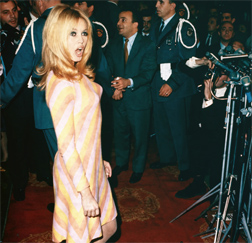
Minh tinh màn bạc Pháp sinh ngày 28/09/1934 ở Paris. Sau một thời gian ngắn làm người mẫu (trong đó có tạp chí Elle), bà thử sức với điện ảnh năm 1952 và nổi tiếng 4 năm sau đó với bộ phim Và Chúa tạo ra đàn bà (Et Dieu créa la femme, 1956) do Roger Vadim, chồng của bà làm đạo diễn. Bộ phim thu hút hơn 4 triệu lượt người xem ở Pháp, hơn 8 triệu ở Mỹ. Và huyền thoại Brigitte Bardot ra đời, với mái tóc vàng dài và luôn mặc trang phục tối giản.
Vai nữ chính trong phim Và Chúa tạo ra đàn bà được AFP đánh giá là một trong năm vai “để đời” của Brigitte Bardot, cùng với La Vérité (Sự thật, 1960, được để cử giải Oscar, thu hút 5 triệu khán giả ở Pháp), Le Mépris (tạm dịch Sự khinh miệt, 1963), Viva Maria (1965), L’ours et la poupée (Con gấu và búp bê, 1970).
Năm 1973, sau khoảng 45 bộ phim, Brigitte Bardot kết thúc sự nghiệp điện ảnh với phim L’histoire très bonne et très joyeuse de Colinot trousse-chemise của Nina Companeez. Bà dành toàn bộ thời gian, công sức cho Quỹ Brigitte Bardot bảo vệ động vật, phản đối săn bắt hải cẩu ở Canada.
Brigitte Bardot là biểu tượng tự do cho nhiều thế hệ nữ diễn viên, nghệ sĩ sau này. Tuy nhiên, bà cũng thường xuyên gây tranh cãi khi chưa bao giờ che giấu mối quan hệ thân thiết với đảng cực hữu Mặt Trận Quốc Gia, sau này là Tập Hợp Dân Tộc, từ 1997-2008. Bà từng bị kết án 6 lần, trong đó có cáo buộc kích động thù hận chủng tộc vì những phát biểu chống cộng đồng Hồi giáo.
Gần đây hơn, Brigitte Bardot đã giữ khoảng cách với phong trào nữ quyền Me Too. Bà khẳng định là thấy “quyến rũ khi được khen là xinh đẹp hoặc có cặp mông xinh xắn, dễ thương”.
Thu Hằng
(Nguồn : rfi.fr/vi)
Brigitte Bardot, French Screen Legend And Style Icon, Dies At 91
By Isobel Thompson
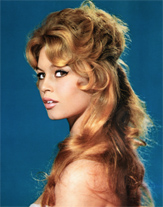
Brigitte Bardot, the French actor, style icon, and animal activist who fixated the world with her insouciant, smoky-eyed sensuality, has died aged 91.
The news was shared by the French news agency AFP, along with a statement from the Brigitte Bardot Foundation. “The Brigitte Bardot Foundation announces with immense sadness the death of its founder and president, Madame Brigitte Bardot, a world-renowned actress and singer, who chose to abandon her prestigious career to dedicate her life and energy to animal welfare and her foundation,” it read.

An early architect of the cult of celebrity, Bardot masterfully harnessed the energy of the Swinging Sixties, framing herself as a free-spirited embodiment of a changing world. Starring in 47 films, several musicals, and recording an album with Serge Gainsbourg, Bardot (or BB, as she was widely known) became, in the words of Charles de Gaulle, “a French export as important as Renault cars.” In 1973, she turned her back on film at the height of her stardom, with a total commitment to her cause: animal rights.
Born a brunette in 1934 (she dyed her hair blonde in 1965, for the Italian film Mio Figlio Nerone), the daughter of Anne Marie and Louis, Bardot grew up in an upper-middle-class Parisian home, attending private school three days a week and dancing ballet for the remaining two. Later, at the Conservatoire de Paris, she danced under the Russian choreographer Boris Knyazev for three years.
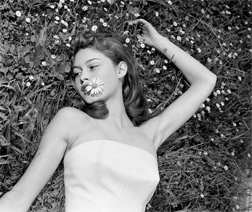
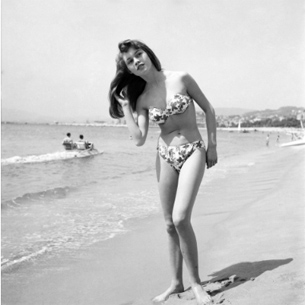
Aged 15, after appearing on the cover of Elle, Bardot was noticed by budding film director Roger Vadim, who persuaded Marc Allegret to invite her to audition for Les Lauriers Sont Coupes. Although Bardot didn’t get the role, it was a pivotal moment: her interest in acting was piqued, and she also fell in love with Vadim. When the relationship was forbidden by her parents, Bardot made the first of four failed suicide attempts; she would continue to struggle with severe depression throughout her life. Eventually, her parents relented – but forbade the pair from marrying until she was 18, which they did in 1952.

Although they divorced four years later after she had an affair with co-star Jean-Louis Trintignant, it was Bardot’s relationship with Vadum that propelled her to international stardom. For his directorial debut, And God Created Women, Vadum cast Bardot as Juliette – a fierce, seductive teenager stuck in a small town. The film was poorly received by conservative factions of France, who were particularly incensed by a scene that saw Bardot dance barefoot, her hair loose and dishevelled.

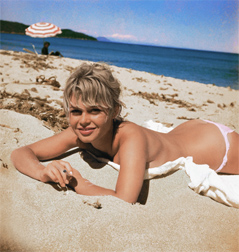
In America, the movie was rapturously reviewed (“I owe everything to the Americans,” Bardot once said). The fiercely physical French actress chimed with the zeitgeist, with a charged, corporeal defiance that pushed back against the rigid decorum of the 1950s. “It isn’t what Mademoiselle Bardot does in bed but what she might do that drives the three principal male characters into an erotic frenzy,” wrote the New York Times critic Bosley Crowther. “She is a thing of mobile contours – a phenomenon you have to see to believe.”

Bardot’s influence went far beyond the world of film critics, however. She is widely credited with making the bikini mainstream. Frequently pictured wearing Breton tops on the French Riviera, she married her second husband, Jacques Charrier, in pink gingham, a look that was immediately adopted by countless women, and even has a neckline named after her. An Andy Warhol muse, she invented the Bardot pose, which – later imitated by Monica Bellucci and Elle MacPherson – sees the subject dressed in black tights, with her arms crossed over her breasts.
Idolised by the young John Lennon and Paul McCartney, who had plans to shoot a film featuring Bardot and the Beatles, Bob Dylan was equally transfixed. According to the liner notes of his first album, he dedicated the first song he ever wrote to her.
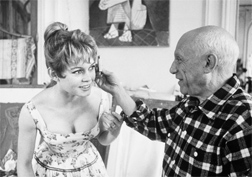
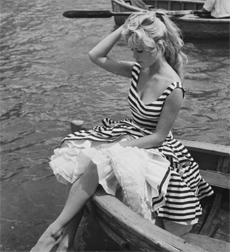
Indeed, Bardot’s impact on popular culture was so gargantuan that, in 1958, Raymond Cartier, then-editor of Paris Match, commissioned an eight-page investigation of “le cas Bardot,” enlisting psychologists, anthropologists, and sociologists to unpick the power of her influence.
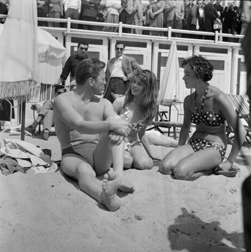
Bardot also captured the minds of a clutch of French intellectuals, intrigued by the political ramifications of her subversive beauty. Bardot’s overt sexuality was regularly attacked as morally corrupt, eroding the fabric of French society. Later, she declared she had had over 100 lovers, some of whom were women.
In a 1959 essay titled The Lolita Syndrome, Simone de Beauvoir dubbed Bardot the “locomotive of women’s history,” presenting her as the first liberated woman of post-war France. “Bardot’s naturalness seems more perverse than any kind of sophistication,” she wrote. “To despise as she does jewels, makeup, and high heels is to refuse to transform oneself into an idol. It is to assert oneself the equal of men… this is precisely what made her appear so dangerous in the eyes of society.”
And then, in a striking act of defiance, just short of her 40th birthday (which she marked with a nude photoshoot with Playboy) Bardot retired from acting, preserving her on-screen image as her younger self. “I was really sick of it,” she said to Vanity Fair. “Good thing I stopped, because what happened to Marilyn Monroe and Romy Schneider would have happened to me.”
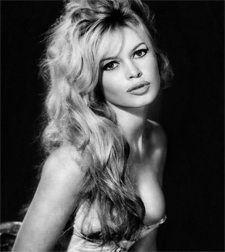
Turning down roles opposite Frank Sinatra and Steve McQueen, and a million-dollar paycheck to act alongside Marlon Brando, she shut herself off from Hollywood. “I live the life of a farmer,” she said, in a piece for The Guardian titled, ‘I couldn’t wear Lagerfeld while feeding my goats’.
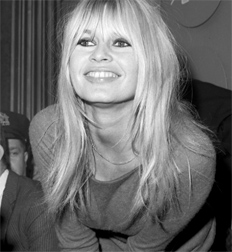
Publishing her autobiography, Initiales BB, on her 62nd birthday, she described flailing behind the veneer of the ideals she had been boxed into: those of a liberated, self-confident sex-kitten. “When you live such intense moments as I have done, there is always a bill to pay,” she wrote. Referring to her multiple suicide attempts, she said: “You cannot escape the distress which follows great happiness.” One of these attempts took place shortly after her son Nicolas was born; she didn’t want the pregnancy, she said, but was persuaded to keep her baby. “I’m not adult enough,” she said at the time. “I know it’s horrible to have to admit that, but I’m not adult enough to take care of a child.” Her public misgivings about motherhood and marriage sparked public outrage and destroyed her relationship with her son in the process.
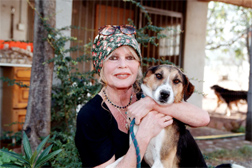
Turning her focus to animal rights, Bardot became a prolific writer of letters, pressuring multiple politicians through her pen. In 1999, ex-Chinese President Jiang Zemin received a particularly acerbic note, published in French magazine VSD, which accused the Chinese of torturing bears and killing the world’s last tigers and rhinos to make aphrodisiacs. More recently, she wrote an open letter to Karl Lagerfeld’s fluffy white cat, Choupette, urging the feline to try and persuade the designer to stop using fur.
Opposing the slaughter of horses, the killing of baby seals in Canada, industrial farming, bullfighting and hunting, Bardot sold many of her possessions at auction to raise money for animals, including some of the jewellery given to her by her third husband, the German millionaire, Gunter Sachs, with whom she had a brief, three year marriage in 1966 (“I never get hung up on the past – the memories are too negative,” she explained to Vanity Fair). Their divorce was not acrimonious, and after Bardot sold her wedding ring, Sachs managed to track it down and give it back to his former wife. She was said to be distraught when he killed himself aged 78 at his chalet in Gstaad.
Bardot’s passion for animals was eccentric – in 2015, she pressed François Hollande to grant a “presidential pardon” to hundreds of wild Alpine mountain goats due to be culled because of an infection. But, considered in the context of her delicate mental health, and the turbulence of her personal and professional lives, it was rooted in poignancy. “Animals have never betrayed me,” she once explained. “They are an easy prey, as I have been throughout my career. So we feel the same. I love them.”
In 1958, Bardot moved to Saint-Tropez, and transformed the tranquil coastal region into the de rigueur destination for the jet set. Indeed, after she turned down Sachs’s first marriage proposal, he arranged for a helicopter to shower hundreds of red roses over her house, La Madrague. “It’s not every day a man drops a ton of roses in your backyard,” she wrote in Initiales BB.
Bardot lived at La Madrague with her fourth and final husband, Bernard d’Ormale, a former adviser to the Front National, whom she married in 1992. The duo seemed to share political inclinations. In a 2014 interview with Paris Match, Bardot described the far-right leader Marine Le Pen as “the Joan of Arc of the 21st century,” and later urged voters not to back Emmanuel Macron in the French elections, saying his lack of empathy for animals could be seen in “the coldness of his steel eyes.”
In 2008, Bardot was convicted of inciting racial hatred for the fifth time, after sending a letter to Nicolas Sarkozy, then Interior Minister for France, stating her objections to the Muslim festival Eid al-Adha, which traditionally involves the slaughter of sheep. “I am fed up with being under the thumb of this population which is destroying us, destroying our country and imposing its acts,” she wrote in a letter later published by her foundation. Fining her €15,000, the prosecutor said she was tired of charging Bardot with such crimes.
Two years later, Bardot lashed out at director Kyle Newman, who was planning to make a Bardot biopic, presumably inspired by the twining of fantasy and reality that defines her story, and the chasm between the public image of Bardot and her reality: someone bold, flawed, and tenacious. “Wait until I’m dead before you make a movie about my life,” she warned, otherwise “sparks will fly.”
(Source : vogue.co.uk)
 thân tri
Thảo luận
Không có bình luận