There’s a reason why viewers can’t look away from Vermeer’s masterpiece.
By Tibi Puiu

When you stand in front of Johannes Vermeer’s “Girl With The Pearl Earring,” something extraordinary happens in your brain. The 17th-century Dutch painting has long mesmerized viewers, but scientists now believe they’ve uncovered the reason behind its allure. It turns out, the secret lies in the unique way your brain interacts with the painting.
For the first time, neuroscientists have measured brain activity while people gaze at the “Girl,” and the results are striking. The researchers discovered that the painting triggers a unique neurological effect they’ve dubbed the “Sustained Attentional Loop.”
A Painting That Pulls You In
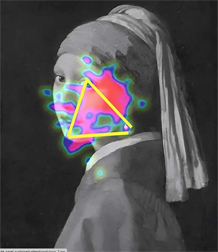
The “Sustained Attentional Loop” is a phenomenon in which the viewer’s eye moves in a repeated cycle around key points in the portrait. When you look at the painting, your eyes are first drawn to the girl’s gaze, then down to her mouth, over to the pearl earring, and back to her eyes. This cycle keeps your attention locked in place, making it difficult to look away.
“You have to pay attention whether you want to or not,” said Martin de Munnik, a researcher from Neurensics, the company behind the study commissioned by the Mauritshuis Museum in The Hague, which houses the famous portrait. “You have to love her whether you want to or not,” the researcher added.
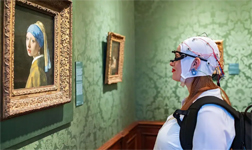
The research utilized eye-tracking technology in conjunction with both electroencephalogram (EEG) and MRI brain scans on 20 volunteers. It showed that the longer someone looks at the painting, the more deeply they connect with it. This may help explain why the “Girl” is among the world’s most beloved artwork.
The team also found that the part of the brain known as the precuneus was highly activate during the viewing experience. This area is linked to consciousness and self-reflection, suggesting that Vermeer’s masterpiece may tap into something personal and intimate within each viewer.
“It was predictable that the Girl was special. But the ‘why’ was also a surprise to us,” de Munnik admitted.
“I believe it,” said Herma van der Werf, 65 and from Zwolle, who visited the museum when the study launched. “You keep looking back and forward, while with some paintings you look at one part. And when you walk, it feels like her eyes go with you. It is very beautiful.”
(Source : zmescience.com)
 thân tri
Thảo luận
Không có bình luận