Tasos Kokkinidis
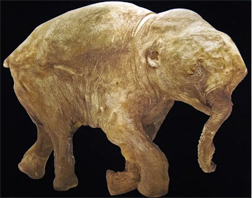
Russian scientists presented the carcass of a baby mammoth, whose incredibly well-preserved remains were found in the Siberian region of Yakutia in June after more than 50,000 years.
The carcass of the female juvenile mammoth, nicknamed Yana, was discovered by local residents after a permafrost crater expanded, according to Russian state media outlet TASS.
“We can say it is one of the best-ever found in the world,” Maksim Cheprasov, Laboratory Head of the Mammoth Museum at the North-Eastern Federal University (NEFU) in Yakutsk, told TASS.
Baby Mammoth was one year old
According to Cheprasov, the baby mammoth was about one year old when it died and weighed around 397 pounds [180 kilograms]. The geological age, according to the results of radiocarbon analysis, is 50,000 years, TASS wrote.
The researchers believe mammoth juveniles grew faster than the offspring of horses, bison and wolves today due to weather conditions being more severe back then.
“They needed to become large in order to endure the harsh winter,” Cheprasov said, according to TASS.
The mammoth remains were discovered in the Batagaika Crater, which has steadily expanded since the 1960s, revealing other prehistoric finds including a horse and bison, TASS reported.
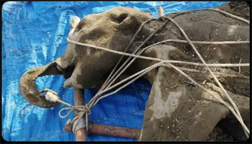
Local residents discovered the carcass after a portion of the crater collapsed, revealing half of the mammoth. The front part of the carcass fell to the bottom of the hole, while the back half including the hind legs were still in the permafrost, Cheprasov said. The back half was later collected by his colleagues.
Before this baby mammoth was discovered, a total of six complete mammoth skeletons have been found in the world, five in Russia and one in Canada, according to Cheprasov.
“This is a really unique find, not only for our university, and for Russian science, but also for the world,” said Anatoly Nikolaev, the Rector of the North-Eastern Federal University, to TASS.
Mammoth mummies in Siberia
Siberia is well-known for its vast, frozen tundra, and the extreme cold temperatures have played a significant role in preserving the remains of these ancient creatures.
The preservation of mammoth mummies is often due to the process of natural freezing. When these animals died in the cold regions of Siberia, their bodies were quickly covered with snow and ice, protecting them from decomposition and scavengers.
Over thousands of years, the frozen conditions kept the bodies intact, and in some cases, the remains have been incredibly well-preserved.
Horses, bison, rhinos, and more have been found— but the most famous mummies belong to woolly mammoths, specifically juvenile mammoths.
(Source : greekreporter.com)
 thân tri
Thảo luận
Không có bình luận