Re-entering Earth’s atmosphere is often described as the most terrifying challenge astronauts face. Hurtling at hypersonic speeds through blazing plasma, they confront extreme heat, intense g-forces, and the thin line between success and catastrophe.
By Arezki Amiri
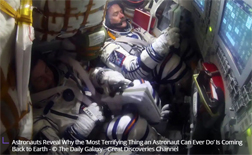
The notion of leaving Earth’s atmosphere for the vast unknown of space has long captured humanity’s imagination. Yet for astronauts, the most perilous aspect of space exploration is not the journey into orbit but the return home. Re-entering Earth’s atmosphere, often described as the “most dangerous thing an astronaut can ever do,” combines extreme physical, technical, and psychological challenges. Their candid reflections reveal a process that is both awe-inspiring and harrowing.
When the Atmosphere Becomes Your Biggest Threat
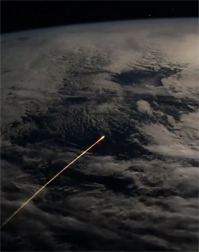
As spacecraft approach Earth’s atmosphere at hypersonic speeds—approximately 28,163 kilometers per hour (17,500 miles per hour)—the sheer velocity creates friction intense enough to generate temperatures exceeding 3,000 degrees Fahrenheit. This fiery ordeal produces a plasma sheath around the spacecraft, often visible as bright orange and purple flames.
Astronauts who have witnessed this inferno first-hand recount its terrifying beauty, visible through the small windows of their spacecraft. One astronaut likened the experience to “flying a meteorite home,” an apt metaphor for the volatile and uncontrolled appearance of the descent.
At these speeds, the physics of deceleration becomes paramount. Specialized thermal protection systems are essential to prevent catastrophic failure. Spacecraft like the Russian Soyuz or NASA’s Space Shuttle are equipped with heat shields that either dissipate heat through controlled burning or deflect it with advanced materials such as carbon composites. The stakes are monumental; even minor errors in trajectory or shield performance could spell disaster.
Returning to Earth is ‘Pretty Scary’
Technological advances are helping to ease the physical challenges of re-entry. But the psychological toll on astronauts is immense. The sheer sensory overload of the experience—blazing flames, vibrations, and extreme g-forces—can overwhelm even the most seasoned professionals.
As one astronaut observed, “It’s pretty freaking scary.” Their focus must remain razor-sharp as they navigate these high-risk moments, where the margin for error is virtually nonexistent. Social media responses to these revelations often highlight admiration for the astronauts’ bravery. Many people express disbelief at how these individuals can maintain composure in such an environment.
One user humorously remarked, “My brain would paint all the disaster images, and I’d be hyperventilating.” Indeed, it is the relentless training and psychological preparation that enable astronauts to face this ultimate test of endurance.
The Profound Impact of Space Travel
While re-entry is a stark reminder of the dangers inherent in space travel, astronauts often emerge with a transformed world-view. The phenomenon known as the ‘Lightbulb Moment‘ describes the profound emotional response astronauts feel when viewing Earth from space—a fragile, interconnected planet suspended in the void.
NASA astronaut Ronald Garan once remarked that this perspective made him realize humanity’s shared destiny and the importance of collaboration. Such reflections often remain with astronauts for the rest of their lives, informing their perspectives on global issues.
(Source : dailygalaxy.com)
 thân tri
Thảo luận
Không có bình luận