Kwan Wei Kevin Tan
The success of Ukraine’s latest missile strike on a major shipyard in Russian-controlled Crimea appears to show just how futile Russia’s defenses were.
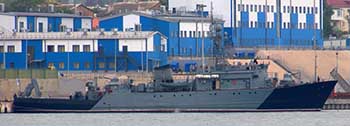
In June, open-source naval researcher H I Sutton spotted dark bands of paint on Russian warships in Sevastopol, which were thought at the time to be a form of camouflage used to confuse Ukrainian maritime drones.
At least four vessels had these bands of paint on them, including the Russian frigate Admiral Essen, seen via satellite imagery at the Crimean port of Sevastopol on June 22.
“It would appear that in this case, the camouflage is primarily geared towards ensuring that at very long distances, a low-quality electro-optical sensor might not distinguish the vessel from background clutter,” Sidharth Kaushal, a research fellow in sea power at London’s Royal United Services Institute, told Insider in July.
If the Russians thought the paint would provide enough defense, Ukraine proved them wrong this week.
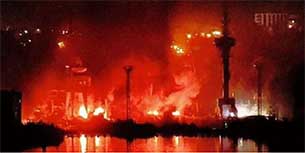
The Russian Black Sea Fleet’s base in Sevastopol, a city in Russia-controlled Crimea, was attacked by missiles in the early hours of Wednesday.
Two ships were damaged while undergoing repairs, per a statement from Russia’s Ministry of Defense. The statement did not specify which vessels got hit in the attack.
According to footage and photos from the blast, the two targets struck by missiles appeared to be a submarine and a landing craft. It is unclear if the two vessels hit in Wednesday’s attack had the camouflage stripes painted on them.

Ukraine’s plans to strike Sevastopol and the Russian Navy’s fleet have been a long time coming. They date back to September 2022 — when Elon Musk refused to turn on access to Starlink satellites, which could have been used to guide Ukraine’s drones to their targets in Crimea, per an excerpt from the Walter Isaacson-penned book about Musk.
Musk, for his part, has defended his decision to not turn on Starlink access in Crimea.
In a podcast appearance uploaded to X on Tuesday, Musk said enabling such an attack, in his opinion, could have resulted in a “mini Pearl Harbor” and “a mass escalation of hostilities.”
A year later, the same kind of attack happened anyway.
(Sources : businessinsider.com)
 thân tri
Thảo luận
Không có bình luận